Niger
Long months of hunger between meager harvests hold Niger's families in a brutal grip. Mercy Corps is helping them break free.
Latest News
Posted July 23, 2010 by Roger Burks
Responding to Niger’s latest hunger crisis
Country: Niger
Topics: Agriculture, Hunger

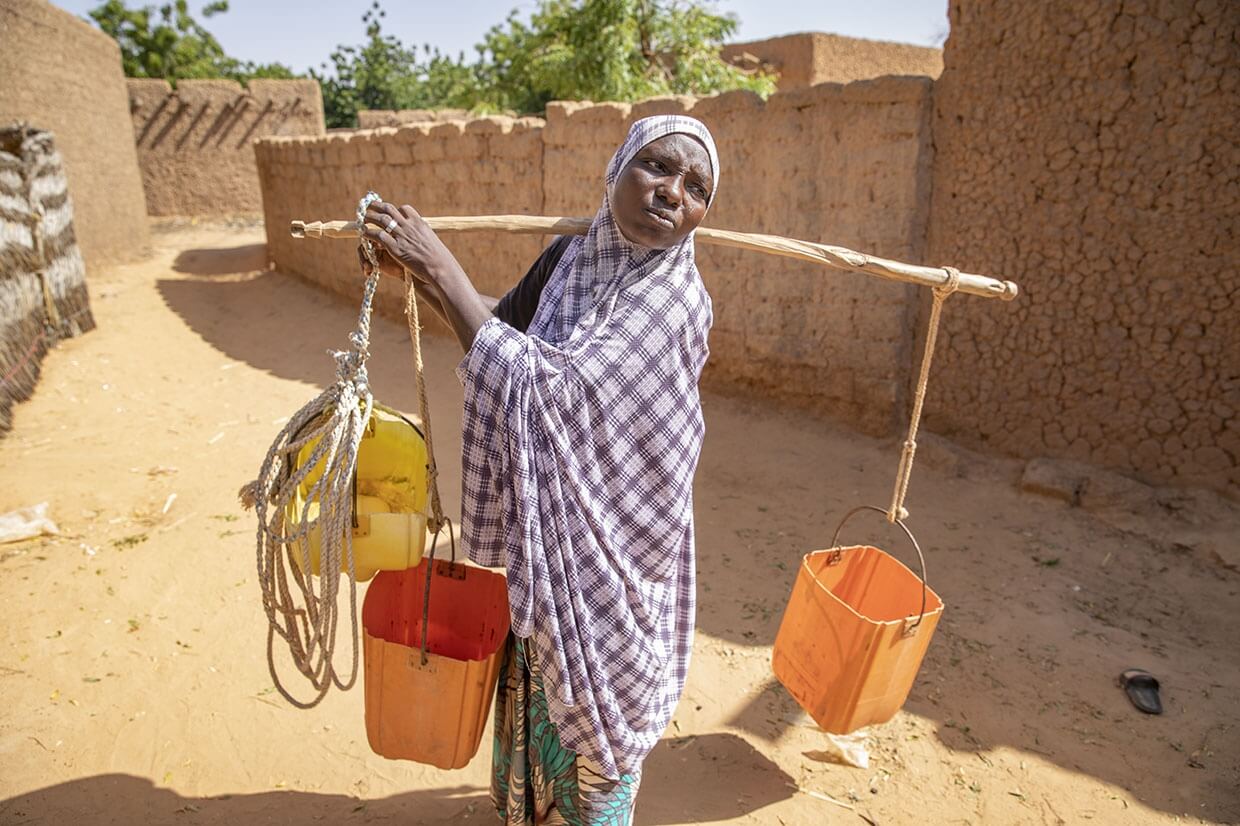
Photo: Thatcher Cook for Mercy Corps
Five years ago, Mercy Corps responded to a catastrophic food crisis in Niger that put more than 3.5 million people at risk of malnutrition and starvation. Today, Niger is facing potentially worse food shortages — and Mercy Corps is again readying a lifesaving response.
This year, as many as 7.8 million people — more than half of Niger’s total population — face the grim prospect of months without sufficient food. Sporadic rains during the last growing season have had a devastating effect on harvests and food supplies, leaving households with little to save for the long “hungry season” between harvests. There are already widespread reports of families — particularly women and children — skipping meals and having to forage for semi-edible grasses, leaves and other wild food.
They need help to survive until the fall harvest, and the Government of Niger has requested urgent assistance from the international community.
Mercy Corps — which has worked in some of Niger’s poorest villages since 2005 – has plans to deliver food and other critical assistance to more than 211,000 people threatened by the hunger crisis. Through government grants, private support and partnerships with local organizations, we will supply nutritious food to vulnerable households while helping farmers address issues of debt from previous poor harvests. Through a microfinance partner, we will extend credit to farming families in order to help them get back on their feet and better able to support themselves.
Every cycle of hunger in Niger drives already-struggling families deeper into poverty. This year, we’re determined to not only help them feed themselves, but also strengthen their ability to emerge from crisis.
Over the last five years, our work in Niger has helped save and change lives: we’ve ensured therapeutic food for more than 60,000 malnourished children and mothers. Our team has also helped improve maternal and child health by working with local authorities to build community health networks that have reached at least 370,000 people in 547 villages.
This year, hunger threatens Nigerien families once again. We are prepared to respond, and your support will help us save lives in one of the world’s poorest places.
Posted September 16, 2009 by Roger Burks
Devastating Floods Sweep Niger
Country: Niger
Topics: Emergencies
Mercy Corps is sending an emergency response team to meet the critical needs of families in areas of Niger affected by recent torrential rain and catastrophic flooding.
Your generous donation to our Emergency Response Fund can help us rush much-needed items and assistance to people in one of the world's poorest countries.
Over the past few weeks, large swaths of Niger have been inundated by devastating floodwaters. According to Niger's government, at least 32,000 houses have been destroyed in almost 50 villages. The flooding is affecting six out of Niger's eight regions, and the rains continue to fall. Thousands are displaced.
Not only have the floods swept away tens of thousands of homes, but they've also killed livestock and wrecked croplands. There are worries that this most recent disaster will trigger a food crisis, since next month's harvest has been jeopardized by the flooding. Most of Niger's 12 million people depend on their own fields for both food and income — if crops are lost, it's extremely difficult for families to survive.
Mercy Corps' emergency teams are traveling to some of Niger's most remote and impoverished villages to determine and address needs.
Our experience in Niger began with a lifesaving response to the 2005 food crisis, when we helped restore the health of 60,000 malnourished children and mothers in 130 villages. Since then, we've helped strengthen health care in Niger's rural areas, reaching more than 370,000 people in 547 villages.
Your gift today to our Emergency Response Fund, combined with our experience on the ground, will make an immediate difference for Niger's families. Thank you for your support.
Posted September 15, 2009
Shipping Medicines to Niger
Country: Niger
Topics: Health
What can one shipment of donated medicines do? How about treat 20,000 mothers and children in Niger suffering from common maternal and childhood illnesses.
Niger is one of the poorest countries in the world. Mercy Corps works side by side with doctors, nurses and public-health officials in the tiny West African nation to improve care for pregnant women and small children.
We've developed a programme to restore severely malnourished children to good health, and we train community health teams to conduct home visits and village education sessions. Our goal: to ensure vital perinatal care reaches 80 percent of pregnant women in the area.

True to Niger fashion, the transfer of such a valuable donation needed to be accompanied with a televised ceremony that included a prayer for the local imam and speeches by the Canton Chief, Commune Mayor, Departmental Prefect, Mercy Corps Deputy Programme Manager, Chief Doctor, and President of the Community Health Management Team. In this image you see the Canton Chief giving his speech and being filmed. Photo: Mercy Corps
As part of our efforts, we recently shipped more than 60,000 doses of various medications — medicines such as penicillin, antibacterial, anti-infective agencies, anasthetics. These drugs were specifically selected for this project because they were identified by the districts as being the most needed and most difficult drugs to acquire locally.
The medicines will improve the health of 20,000 pregnant and lactating mothers and their children under three years old. The medicines were delivered to clinics in the Filingue and Loga districts — two of the poorest, driest and most precarious areas of the landlocked country.
Our shipment represents a six-month supply for the clinics in Filingue and Loga. Help us do more with a donation to our shipping appeal. Your $1 sends £42 worth of medicines, books, clothing and other critical supplies to people in need.
Blog Post: Posted August 31, 2009, 12:47 pm by Roger Burks
Climate change and Niger
Country: Niger
Global warming is not only causing already-meagre water supplies in the West African nation of Niger to dry up — it's also driving young men from drought-stricken rural areas in search of work to provide for their families. This migration to increasingly-overcrowded urban areas is further straining the resources of one of the world's poorest countries.
Mercy Corps has been working in Niger since 2005, the year a catastrophic drought and food shortage left millions fighting for survival.
In a piece he wrote for ONE, Mercy Corps Action Centre Executive Director Robert Sherman describes the still-unfolding situation and presents a video that provides insight through a Nigerien farmer named Namata Abba.
Video: Posted January 5, 2009 by Jacob Colie
Fighting Malnutrition
Country: Niger
Topics: Food/Nutrition
The Cycle of Hunger:
Posted April 10, 2007
Q&A with Christy Collins
Country: Niger
Christy Collins, who currently serves as Mercy Corps Niger's country director, has a long history with the country and people of Niger. She first came to Niger in 1975 as a Peace Corps volunteer, having just graduated from college with a degree in French.
Collins arrived in Niger at the end of a serious drought and began working on infant health programmes in small rural clinics. She helped start a rehabilitation centre for malnourished children, and also assisted local nurses and traditional midwives in their work. Collins often traveled by canoe to reach isolated villages on the broad Niger River.
After her Peace Corps service ended, she remained in Niger for an additional two years working for various organisations on projects that included agriculture, forestry and water.
She returned to Niger in 1993 to work on a USAID pilot programme to help Niger's people take measures to improve their food security. Collins stayed until 2000, before coming back for a third time in 2005 to spearhead Mercy Corps' health and therapeutic feeding programme.
Q: What keeps you coming back to Niger?
Christy Collins: I have always looked forward to returning to Niger. Not only has each experience offered an opportunity to contribute to development efforts, [but] I also am deeply grateful for the professional collaborations, the friendships and the diversity of each experience. While I aim to contribute significantly, I am constantly challenged to re-evaluate my perspectives, understand the evolution of the social, economic and political contexts, and find ways to concretely help address Niger's priorities.
What are the biggest challenges facing Niger's people - specifically its poorest families - today?
Since some of Mercy Corps' health programmes are in the capital city, Niamey, I'd like to evoke the migrant families from rural areas staying in Niamey as among the poorest and most vulnerable populations we work with (since they also come from the poorest families in the rural communities).
These migrants likely feel little link to the urban community, and thus do not easily seek access to public services. I don't think that many of the kids of these families go to school. Nor do family members seek medical attention unless they are very ill, as services are not free and often cost well beyond what the poorest can pay. The plight of the migrant urban poor is the most dire.

Families in Niger's isolated towns, such as those in far-flung Sanam, live in challenging conditions like generations before them. Photo: Thatcher Cook for Mercy Corps
What are some of the biggest opportunities for positive change?
[Recent] elections of local councils represent an opportunity for increased participation and contributions by all Nigeriens to governance and development processes. With local officials closer to their consituencies, diversity and level of participation are increasing.
It is important to work with youth, given their readiness to participate in economic, social and civic activities. We talk of the ‘youth bulge' now, but I think that we have yet to see the even bigger bulge ahead - just stand outside a primary school and hear the roar! The youth of today need us to model and address what they will have to face themselves tomorrow.
The Government of Niger and international partners have recognized the imperative to develop sustainable frameworks to prevent crises such as [the food crisis of 2005] through support to the public health sector and local communities. This provides the context for continued and richer participation in tracking and treating childhood diseases locally, and making a real difference in the lives of many families.
How did the food crisis change Niger, and how is that crisis continuing to affect the country and its people?
There have been cycles of famine for various reasons throughout the history of the Sahel. Nigeriens have coped with them in many ways.
The difficult access to food witnessed by vulnerable Nigerien populations in 2004 resulted in particularly high levels of debt among farmers. [Unfortunately] they were unable to completely overcome that debt through the sale of portions of their 2005 and 2006 harvests, much less ensure that their stocks were sufficient for the entire year until the next harvest.
For pastoralists, loss of livestock was aggravated and in many cases they have been unable to reconstitute their herds. This inability to immediately overcome is one reason for the continued significant out-migration [to urban areas like Niamey] by young men, women and families. And it's also why they continue to be at-risk for further market and production instability.
In Niger, news of rain is a valued topic of conversation. I find myself feeling and sniffing the air to be as tuned in as my colleagues. But the signficance of any hint of rain is immensely more profound to Nigeriens whose livelihoods depend entirely on the amount and timing of rainfall.

The people of Niger are often threatened by drought and famine, but remain determined, resilient and proud of their colourful cultures. Photo: Thatcher Cook for Mercy Corps
What's the one best thing you think that Mercy Corps has done since arriving in Niger?
We have supported the integration of nutrition rehabiiltation programmes into the operations of 92 rural public health centers, and supported community volunteers to assist the government's health staff in undertaking this work. This has lead to the admission of more than 40,000 at-risk and malnourished children since the programme's inception in September 2005.
The initial reticence of some nurses has evolved to engaged commitment with village health agents and volunteers, and community health committees are now fully participating with public services in health monitoring, reporting and coordination. This activity has led the public system to improve its performance in other areas as well, such as vaccination coverage.
What would you like to see Mercy Corps doing in the future in Niger?
I would like Mercy Corps to provide leadership in innovative programming with a focus on the health of women and young children. While our emergency response activities have been successful, it is necessary to develop longer-term commitments to reducing the risk of miscarriage, undernutrition and malnutrition in women and for the overall health of children under 5 years old, in continued partnership with public services and communities.
I would also like Mercy Corps to contribute to the well-being of rural families through linkages between migrants (primarily youth), land restoration techniques, agricultural diversification and productivity, vocational training and civic participation.
How can Americans best help the people of Niger?
Keep the populations of Niger in your minds and hearts, and be proactive in finding an area to support. Be aware of the position of your representatives and senators on issues related to Africa, the Sahel, and Niger in particular. Keep abreast of news of Niger and support fundraisers for Niger activities. Many American and international [organisations] are doing excellent work in Niger.
Mercy Corps programmes in Niger are in their initial phases. While our expertise in certain geographic zones and sectors is increasing, continued innovative programming requires the means to conduct probing assessments to guide and inform concepts and strategies. We rely on private funds for this.
There are also important programme costs for which it is difficult to find donors: for example, the cost of [effective] treatment of malaria for children is very high. I would like to make an appeal directly for a supply of these malaria treatments for children, as malaria is one of the main threats to the life of a malnourished child. It is also one of the main causes of reaching a stage of malnutrition where the child's growth and life are compromised.
What's one thing that the world might not know about Niger that you'd like to share?
Public perceptions of Niger are most likely shaped by the images of suffering children and vulnerable families.
I would like the public to know that there are sharp, lean, agile and animated primary-schoolers skipping to class, holding hands; persistent mothers who walk 40 kilometers round-trip for a weekly dose of treatment rations for their children; dedicated mayors who meet their constituents at the market and hold open air briefings on the community's latest news; young men and women bursting to contribute and establish themselves.
We are the same.
Please donate to our Emergency Response Fund to help us continue and expand our innovative, lifesaving programmes in Niger.
The Cycle of Hunger:
Posted April 10, 2007 by Roger Burks
Fati: Taking Action for Her Son
Country: Niger

Fati Issia sits with her seven-month-old son, Moctar, at the Dar es Salaam health clinic in Niamey. Photo: Thatcher Cook for Mercy Corps
Niamey, Niger - Fati Issia seems alone in the crowd.
In the midst of the boisterous waiting room at Niamey's Dar es Salaam neighborhood health clinic, she sits quietly while other mothers engage in conversation. She holds her seven-month-old son Moctar on her lap.
This is her first time at the clinic. It is also her first week in Niamey, Niger's bustling capital and largest city.
Fati did not come to Niamey by choice, but through need. The food crisis that's enveloped the entire country is also debilitating local economies. As crops withered in Fati's home village, so did jobs. Fati's husband couldn't find work.
Fati and her husband made a difficult decision to take Moctar and leave everything they'd ever known to come to Niamey in search of opportunity. It has eluded them so far, as it has thousands of other hopeful newcomers to the capital city. Fati, her husband and Moctar are currently living with relatives in a poor section of the city where shanties built on the sides of sandy streets are a common sight.
While food crisis and unemployment remain beyond her control, Fati is taking control of one critical part of her family's life: the well being of her young son. She is one of thousands of young mothers that are seeking nutritional and health advice at local clinics supported by Mercy Corps. This support is helping train hundreds of health workers to gain the skills they need to help protect children like Moctar from the constant peril of Niger's cycle of hunger.
It's not easy for a young mother, especially one as demure as Fati, to come to a place like this and ask for help. But she is committed to giving Moctar a promising start in life - and Mercy Corps is helping.
A healthy new beginning
When we arrive to visit the clinic, Moctar is already on the scale and ready to be weighed. He is alert and curious, surveying the room through eyes wide with amazement. He grabs a slip of paper and carefully examines it.
As Fati sits anxiously in an adjacent chair, a nurse weighs Moctar. I ask the young mother how she found out about Mercy Corps' therapeutic feeding programme.
"A female neighbour - a new friend since I moved here - told me about it," she says self-consciously. "She's been bringing her children here for a few weeks, and they're doing better now.
"She told me the people are nice here."
The nurse turns to Fati and begins to address Moctar's condition.
"He weighs 5.2 kilograms [about 11 pounds]," the nurse says. "For his age and height, it means that he's moderately malnourished."
Fati listens as the nurse thoroughly describes the programme: what she must do at home, how often she should feed Moctar, what food to give him and how often to bring him back to the clinic. Fati nods her head in sincere, thoughtful acknowledgement of each piece of advice.
After the consultation and a time for questions, the nurse writes instructions for Fati to take into the next room, where Fati will pick up supplemental food.
A woman wearing a vibrantly coloured head wrap politely takes the slip of paper from Fati and peruses the instructions. As she measures out cups of UNIMIX - a high-calorie, vitamin-rich porridge - and protein-packed vegetable oil, Moctar turns his head and beams a sweet smile at her. The woman gently laughs and hands bags of food to Fati.
As she leaves the Dar es Salaam health clinic for Niamey's dusty streets, Fati Issia might be questioning what tomorrow holds for her family. There are many needs to be met every day, so many hard questions to consider. But tomorrow and in the months to come, Mercy Corps will be meeting the needs of more than 40,000 children across Niger, including Moctar.
And that's one less thing that mothers like Fati will have to worry about.
The Cycle of Hunger:
Posted April 10, 2007 by Roger Burks
Boubacar: A Nurse's Helping Hands
Country: Niger

Boubacar Harouna (centre) sits with two of Sanam's village elders. Photo: Thatcher Cook for Mercy Corps
Sanam, Niger - You can see the difficulty of life here in Boubacar Harouna's eyes. They are yellowed from chronic malaria and glassy from exhaustion. Still, Harouna somehow summons the energy to treat dozens of patients each day as the town's only nurse.
Clad in an improbably clean, crisp white coat, Harouna makes the rounds to check on his patients - many of whom lay outside under shade trees because of the lack of beds here. One man, so weak from malaria that he cannot sit up or even move, is sprawled out on a dingy mattress with an intravenous drip in his arm.
One of the clinic's few observation rooms holds four-year-old Ousama Mamidou, who was transported here in a donkey cart from a nearby village. Already chronically anemic and severely malnourished, Ousama arrived in convulsions from a malaria fever. Even after treatment with anti-malarial medications and rehydration solution, she's still listless in her mother's arms and fighting for survival.
"You've come on a slow day," Harouna says with no trace of irony on his care-worn face.
Last year, Harouna assisted in 112 births. He kept a busy schedule of prenatal, breastfeeding and child nutrition consultations. He filled the remainder of his days with vaccinations, curative treatments and emergency medical care.
Harouna is on call around the clock. If a patient comes in the middle of the night, he must quickly rouse from sleep and do what must be done. He's never far from his work; he lives with his wife and children in a small house that's attached to the clinic.
A difficult road
He gives me a weary smile as he begins talking about the town he serves and loves.
Sanam is on the fringe of the Sahara Desert. A town of about 28,000 people, it lies in Niger's impoverished Filingue Department. This entire region was hit hard by catastrophic drought and crop-killing insect swarms in late 2004 and again in 2005. People had hardly any millet to harvest as a result. At the height of the food crisis in 2005, more than 3.5 million Nigeriens faced the prospect of starvation.

Harouna administers an antimalarial medicine to 37-year-old Sani Gounabi, who is suffering from malaria. Photo: Thatcher Cook for Mercy Corps
Harouna and other residents of Sanam are hopeful that this year's millet crop will do what the previous two could not: sustain area families until the next harvest. The city must struggle to be self-sufficient; the closest market town is more than three hours away down a jagged road cratered with potholes.
It was up that road that Mercy Corps first arrived here in August 2005, after thousands of caring private donors contributed more than £201,000 to help launch a lifesaving response to Niger's hunger crisis. Within days of beginning an emergency fundraising campaign to help Nigerien families, Mercy Corps quickly deployed experienced aid workers to remote places like Sanam. The task was daunting: identify and treat malnourished children under five years old, while also training local health officials like Harouna to sustain this critical work.
That response, which is ongoing, finally gave Harouna some much-needed support.
"Besides Sanam, this health clinic is responsible for three other villages: Kololo, Magaria and Kordongo," he says. "Mercy Corps has helped us provide support for families there."
With the help of medical professionals like Harouna, Mercy Corps identified dozens of villages where hunger was endemic, including the three villages in proximity to Sanam. Local health centers in these villages began distributing nutritious food to the mothers of malnourished children: UNIMIX, a vitamin-rich porridge for moderately malnourished children and Plumpynut, a protein-packed food for those with severe malnutrition.
Keeping a promise
Within weeks, hundreds of children were "graduating" from the therapeutic feeding programme, having met the target weight for their age groups. In just three months time, more than 4,000 children in Filingue Department regained their health.
Today, there are still 167 malnourished children in Sanam; all of them are moderately malnourished and being treated with UNIMIX.
"There are no longer any severely malnourished children around Sanam," Harouna proudly explains, "and that's a compliment to Mercy Corps and its donors."
Mercy Corps has kept its promise: the programme is currently operating in more than 100 health centers in Niger and providing services to 33,000 children. Over the past year, hundreds of local health officials have been trained how to recognize, treat and - most importantly - prevent malnutrition and the health issues that it causes.
Life is hard in Sanam; Boubacar Harouna knows that better than most. However, some timely help from Mercy Corps is helping to lighten his load.
Please donate to our Emergency Response Fund to give caring physicians like Boubacar Harouna a helping hand.
The Cycle of Hunger:
Posted April 10, 2007 by Roger Burks
Three Wails
Country: Niger
Shortly after midnight, a soft wailing cry broke through the sweltering Sahelian night.
In a small mud-brick room at Sanam's health clinic, bare except for a small bed, 24-year-old Maimou Issoufou gave birth to her third child - a boy. Peaceful and reflective, the baby lay in the arms of the midwife who had attended the birth. According to local customs, he would not receive his name for a week, when a baptism ceremony would celebrate his entry into the world.
After making sure that all was well with the fragile new life, the midwife turned to hand the baby boy to his mother. And then she realized something was terribly wrong with Maimou.
The young mother had turned over on her side, lapsing in and out of unconsciousness, and was obviously in severe pain and distress. What the midwife hadn't realized until then was there was another baby waiting to be born.
But wracked by chronic malaria and weakened by hunger, Maimou was too exhausted to deliver the twin. For hours the midwife and Sanam's local nurse, Boubacar Harouna, courageously tried everything they could think of to help her deliver her baby. Her contractions weren't strong enough. She went to sleep.
As day broke over the edge of the Sahara, the midwife and doctor decided that Maimou couldn't stay in Sanam.
Sanam's tiny clinic is one of nearly 120 health facilities that Mercy Corps is supporting in Niger, the lowest-ranked country on the United Nations' Human Development Index. The people of Niger, already mired in poverty, continue to suffer from chronic undernutrition: more than ten percent of the country's 12 million people are "acutely malnourished."
For nearly two years, Mercy Corps has been helping village-level health centers identify and treat malnourished children, distribute food supplements and provide basic medical treatment. More than 40,000 children have been treated and their families have also benefited from our programmes.
But, despite the determination and energy of Niger's doctors and midwives, village clinics are no match for more severe health problems. Unfortunately, Maimou's worsening condition was too much for Sanam's staff to handle.
Translating urgency
I was just waking up from an uneasy outdoor sleep in the health clinic's courtyard when an older woman wearing a colourful head wrap and heart-shaped earrings approached me. She gently held a newborn baby in her arms and was speaking Hausa in an urgent, yet calm manner.
Since I don't speak Hausa, the predominant language of this part of Niger, I waved over one of my Mercy Corps colleagues - a health officer - to come and translate her words.
"She says that a young mother in the clinic is fighting for survival," he explained. "Her second baby is trapped inside of her and she's too exhausted to deliver."
"How can we help her?" I asked.
My colleague had a brief but intense dialogue with the midwife and then turned anxiously to me. The photographer who I was traveling with, Thatcher Cook, joined the conversation.
"The mother needs to be transported to the regional hospital in Filingué," the health officer said, alluding to the regional capital, a city more than four hours away down a potholed, two-track road. "They can't do anything else for her here."
"Can we take her in our car?" Thatcher immediately asked.
"No," the health officer answered. "She needs to lie down the whole way. There's an ambulance here, but the clinic has no money for gasoline.
"The doctor was wondering," he continued cautiously and a bit uncomfortably, "if you would be able to pay for the gasoline to transport her to Filingué."
I exchanged a quick look with Thatcher; there was no time to mull over an answer.
"How much would it be to get her there and back?" I inquired.
"Gas is scarce here," the health officer responded. "It will cost 20,000 francs [about £24] to fill up the ambulance."
Thatcher and I reached for our wallets, took out some bills, counted them and handed the cash to the midwife, who smiled wearily and nodded her head in thanks. Then she said something to the health officer.
"She would like you to come and see the mother," he translated. "It means a lot that you're doing this for the family."
Somewhat reluctantly, we walked a short distance to the room where Maimou was staying. I felt embarrassed about any recognition for what we were doing; I didn't want to intrude during this family's time of sadness and doubt. I didn't want the young mother's suffering to become a spectacle in any way. At the same time, though, I wanted to be polite and acknowledge our nascent connection with a visit.
We entered the room slowly, and solemnly greeted the family members who stood around her bed. She lay on her side facing the wall, and her breathing was shallow.
We stood there for several minutes, not sure of what to do or say. At one point, I closed my eyes and said a silent prayer for Maimou's health and that of her unborn child.
I felt a hand on my shoulder. It was the field officer, letting us know that it was time for us to depart for our scheduled field visits. As we quietly shuffled out of the room, I felt woefully inadequate. Sure, we had just provided money for Maimou's transportation to a hospital that might be able to help her. My own humanitarian values, however, nagged at me that just spending money wasn't enough. What else could I have done, though?
I couldn't push that question from my mind as I packed my bags and got ready for the long day ahead.
A half-hour later, after we had climbed into the car and turned onto the road that would take us out of Sanam, the wail of an ambulance sounded high above the stillness of Sanam. It may have been wishful thinking but, to me, it sounded like hope rather than alarm.

Upon waking in Sanam, Burks and his colleagues - who slept outside on these beds the previous night - were approached for help. Photo: Thatcher Cook for Mercy Corps
Waiting at the gate
As we traveled to a few village health clinics that day, meeting dozens of young mothers who had brought their underweight children for therapeutic feedings - the central mission of our work in this region of Niger - I couldn't help but wonder what was happening with Maimou and her unborn child.
We'd soon find out. When our scheduled meetings were complete, our team drove the long, difficult road from Sanam back to our quarters in Filingué, following the same route the ambulance had taken just hours before. I cringed every time we hit a deep pothole or swerved off the road to avoid one.
We arrived in Filingué at dusk. There were two men waiting for us at the gate to the Mercy Corps office. They had news about Maimou.
As we pulled into the Mercy Corps office at dusk, two men - relatives of Maimou that we didn't recognize from earlier that day in Sanam - were waiting for us outside. They told us that the ambulance had brought Maimou to the regional hospital that afternoon, but that the medical staff there had been unable to deliver the baby; her contractions were still not strong enough to give birth. The doctors at the hospital also didn't have the facilities or equipment to perform an emergency caesarean section.
The only place that could help Maimou, they told us, was the main hospital in Niger's capital, Niamey - three hours away. They told us that they'd heard we had helped earlier with gasoline for the ambulance. They needed our help again.
Unlike our first decision, this time I hesitated. I didn't know the men. I also didn't want to compromise Mercy Corps' work in any way by handing out cash and giving any reason for others to expect the same in the future. It was an awkward dilemma; how does one balance long-term considerations with life-and-death immediacy? My conscience screamed that there was an overwhelming moral - and human - obligation to help a young mother clinging to life.
Thatcher suggested that we call the regional hospital to check on Maimou. The doctor we spoke with indicated that while Maimou was still in danger, her condition was stable and the unborn baby was still alive. He thought she was strong enough to make it to Niamey.
I felt a twinge of guilt for deliberating as Thatcher and I counted out 18,000 francs [about £22] and handed it to Maimou's two relatives. They shook our hands, thanked us and hurried off down the dusty dirt road.
That night, after a quiet dinner with my colleagues, I once again had a stifling, restless sleep under the broad, starry sky. I wondered what my colleagues thought of what we had done. I second-guessed my distrust and reluctance in giving money the second time. Most of all, though, I just hoped that what we'd done would help to save two lives that night.
The uneasiness of silence
Early the next morning, we again followed Maimou's path, driving to Niamey to prepare for our next-day departure to Uganda. Once we arrived, we were eager to hear news of Maimou and, hopefully, her new child.
Despite the best efforts of several Mercy Corps staff, no one could find out anything about her - or even ascertain where she was. Thatcher and I deliberated whether or not to go looking for her, but in the end decided that it was better to let the family have their time and space. We had done everything we could.
We left Niger without news of Maimou. It wasn't until two days later, when I checked e-mail in the lobby of my Kampala hotel, that I learned her fate.
I opened the message from Christy Collins, Mercy Corps' Country Director in Niger with a sinking feeling in my heart.
It read:
"I'm sorry to tell you that the woman you helped in Sanam died. I do not know the circumstances - if it was in transit, or after delivery of the second twin (who also did not survive).
"I've a notion to look up the first twin to see if he is doing all right (probably very vulnerable). I'm sure your and Thatcher's care in responding to the mother's needs is appreciated."
In Kampala I bowed my head, prayed and quietly mourned the heart-rending passing of two young lives.
Back in Sanam's health clinic, health staff, with Mercy Corps assistance, was weighing babies, distributing emergency food and helping mothers learn how to keep their young children healthy. Nearby, a long, mournful wail arose from a family that had lost a daughter, a wife, a sister - and her child.
Posted August 22, 2006 by John Hanson
Niger's Faces of Need
Country: Niger
Niger in a time of crisis is not a place for the faint of heart.
I felt this most profoundly one day last June when I found myself handing over sacks of rice, lentils and salt to dozens of mothers in the 2,000-person town of Rwafi. Across from me, in this small cement health post on the southwestern edge of the Sahara Desert, hundreds of eyes met mine. These eyes betrayed the indomitable fortitude and resiliency I have come to expect from women in rural Africa. Yet they also revealed their deepest needs, as each one hoped I would provide them with sacks of rice, lentils and salt, too.
My job on this 110-degree day in the desert, the second of my three-day trip to the Filingué region, was to help Mercy Corps' nutrition team distribute rations to 230 families — a small part of our efforts to ease the persistent food crisis and to bolster the capacity of the country's public health system to detect and treat child malnutrition.
Across this land, hundreds of thousands of children who have survived seasons of drought today simply do not have enough food to eat. Since last summer, Mercy Corps has been helping health centers identify and treat malnourished children, distributing food supplements, providing basic medical treatment and strengthening community health committees. In Rwafi and neighboring villages, 2,404 children under five have been admitted since the programme's start.
Hard times in a harsh land
Few people inhabit this landscape of sand and scrub brush. We passed only a handful of settlements during the three-hour trip from the town of Filingué, a provincial outpost northeast of the nation's capital, Niamey. A lone truck that plies the road between Filingué and Rwafi is the only form of public transportation available. When we passed it on the way, the truck was so overstuffed with people that some passengers rode atop its front hood.
Rwafi's residents live in a cluster of adobe homes surrounded by fields of millet. Millet is Niger's staple grain, and also fodder for goats and cattle. Livestock is both food and currency here. The health centre is the only cement building in town; it has an office, storeroom, a room in which babies were weighed and measured, a waiting area and a couple of beds for inpatients.
Inside, I met Zada Hamidou, the nurse. He's the only trained clinician, as well as the senior administrator, for three health centers that cover about 20,000 people who live within 50 kilometers in any direction. Zada told me Mercy Corps' decision to support local clinics' malnutrition treatment programmes helped draw residents to the health centers for other important medical needs — vaccinations, nutrition advice, family planning information and so on.
After a night spent under the stars on a mosquito-net-covered mattress, my colleague Dare and I awoke to a situation that brought home how precarious life is out here. A woman and her husband arrived in a donkey cart. They had traveled 13 kilometers after she had given birth to one twin. Staff carried her, barely alive, into health centre before she gave birth to the second child.
"Oftentimes, people will wait too long in their villages in childbirth before they seek help," Zada lamented to me later. "These are some of the most difficult situations we face, these women who've not been brought in soon enough."

Women crowd Rwafi's health clinic, hoping to receive some of the sacks of food set aside for families enrolled in a programme to combat child malnutrition. Photo: John Hanson/Mercy Corps
Checking off names for food
Later that day, I checked off the names of the families as they came for their sack of grain. It's the first time in the 14 years I've worked in a variety of international-development roles, mostly in southern and central Africa, that I've seen such malnutrition and need.
Eligibility in the health centers' child nutrition programme is determined by a weight and height standard used by the UN. Qualifying families receive a blue card and their name is put in a ledger. They receive a monthly supply of a soy-based nutritional supplement for children under the age of five. Children who reach desired weight through the assistance and monitoring of health centre staff "graduate" from the programme.
For this day's distribution, Mercy Corps had sent an advance team to Rwafi to explain the eligibility rules and the process to the health centre staff, village chiefs and local health committees. But people here are desperate, so dozens of people not enrolled in our programme took a chance and came in.
I saw children in the malnutrition programme with sunken eyes, skeletal bodies and arms as thin as a roll of dimes. I saw some teenage girls carrying sickly children on their back. And I faced dozens of incredibly strong and determined women who looked at me plaintively in hopes that I would issue them a sack of grain. As a colleague noted, these are the kind of heart-wrenching situations the health centre professionals face every day.
It is easy to see these women as victims — of nature's whims, of political failures, of their unlucky lot in life. To me, however, these women are survivors: strong, capable and determined people who work incredibly hard to provide enough for their families. Their husbands seek work in larger cities only because there are few wages to be earned here. But today, because times are so desperate, even the most resourceful among these families are forced to seek assistance.
Capacity is strengthened, but needs persist
Niger's food crisis shows few signs of subsiding in the area north of Filingué. The rains were already a month late. Beyond the expanse of fields, I saw no gardens or fruit trees to sustain these families. Residents here must purchase their food, either by selling off livestock or extra millet, or by going into debt with local traders. Livestock are increasingly scarce, and the community's three millet storehouses are empty.
"People don't have money to diversify their diet," Zada told me. "Many families are relying on one meal of millet porridge a day." In fact, there are already reports further north of animals dying and migrant workers, usually self-reliant, seeking food aid.
But there is, thanks in part to Mercy Corps, a better early-warning system and stronger capacity to respond. Data from Rwafi's health centre flows into a growing national database intended to help the government identify and respond to areas where food is running short. Village health committees are starting to fill their role of getting word out about what the health centre offers. And Zada reports that he's more regularly visiting the two other health centers under his direction, thanks to Mercy Corps funds to repair and fuel his motorcycle.
But the demands remain overwhelming. In Niger, many people are busy with the simple yet arduous task of survival.


Like us on Facebook ›
Sign up for email updates ›
Follow us on Twitter ›